About the Journal
BARAYA : Journal of Arabic and World Languages Education is a peer-reviewed, open-access academic journal dedicated to advancing research and practice in language education globally. The journal highlights both Arabic language pedagogy and the teaching of other world languages, serving as a platform that connects diverse perspectives and approaches in language learning and education worldwide.
Mission : To provide a premier platform for researchers, educators, and practitioners to share innovative research, theoretical insights, and best practices in multilingual and multicultural educational contexts.
Vision : To become a leading international forum that promotes excellence in language education research while fostering cross-cultural understanding and pedagogical innovation.
Target Readership : The journal serves language education researchers, Arabic and world language teachers, curriculum developers, educational policymakers, graduate students, and practitioners interested in innovative approaches to language pedagogy and cross-cultural communication.
Indexing Status : Currently indexed in Google Scholar and GARUDA, with applications submitted to DOAJ and plans for future Scopus inclusion.
ISSN: [To be assigned]
Publisher: Sekolah Tinggi Agama Islam Raden Abdullah Yaqin
Editor in Chief : Moh. Ferdi Hasan
Frequency: Twice (Juni and December)
Language : English
Started: 2025
Current Issue
Vol. 2 No. 1 (2026): Juni
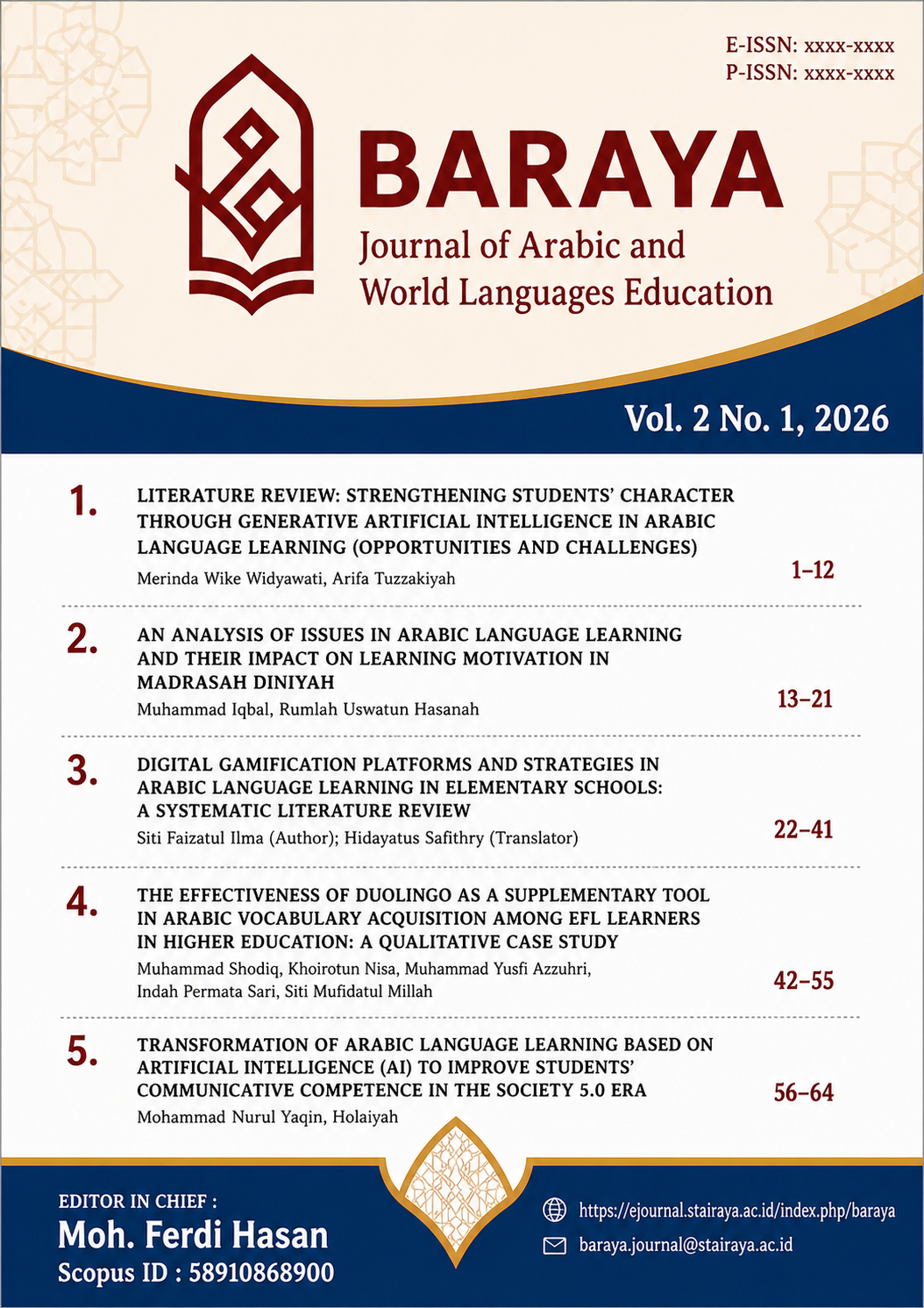
The first issue of Volume 2 of BARAYA presents a collection of scholarly articles addressing current developments, challenges, and innovations in Arabic language education in the digital era. This issue highlights studies on the role of generative artificial intelligence in strengthening students’ character, issues affecting learning motivation in Madrasah Diniyah, and the use of digital gamification to support Arabic language learning in elementary schools. The articles also explore Duolingo as a supplementary tool for Arabic vocabulary acquisition in higher education and the transformation of Arabic language learning through artificial intelligence to enhance students’ communicative competence in the Society 5.0 era. Together, these contributions provide valuable insights for researchers, educators, and practitioners seeking to advance Arabic language education through innovative, technology-supported, and context-responsive approaches.
Published:
2026-08-19
Research Article
Literature Review
You can contact the editorial board for fasttrack review